
US Crop Update
- Tuesday May 29, 2007
This analysis featured in the May 29, 2007 issue of the HGCA's MI Prospects, Volume 9, Issue 23
Key points
- Winter wheat - an above average crop likely to be harvested this year
- Winter wheat crop seen at 44.0Mt, 23% above 2006/07 by USDA
- Spring wheat plantings ahead of last year
- Maize plantings back on schedule and emergence ahead of last year
- Larger forecast maize crop needed to fulfill projected use requirements
- Soyabean crop also off to a good start, but area forecast 11% lower
Anticipated demand for US maize this coming crop year is sufficient to support indirectly the market for wheat and soyabeans, despite generally very favourable harvest prospects for all three crops.
This spring, in contrast to last, moisture conditions were particularly favourable. In early April more than 70% of USDA reporters rated crops as in good or excellent condition and a heavy crop was in prospect (Graph 1). In early April, however, major portions of the Mid-West, central and even southern Great Plains, covering much of the US winter production area, was subject to frost.
continue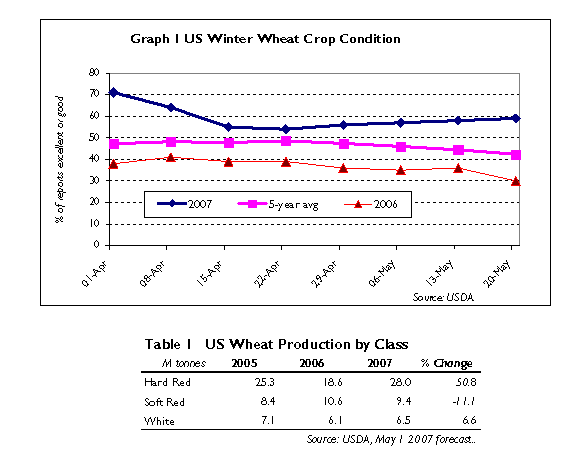 continued
But, subsequent to this, weather for crop recovery has continued to be close to ideal and while some yield potential has been lost, it is evident that an above average crop will be harvested. As of May 20, 59% of USDA crop reporters rated conditions as good and excellent, compared with 30% last year at this time and a five-year average of 42%. The first USDA forecast for winter wheat production placed the crop at 44.0Mt, 23% above year’s harvest (Table 1). Most of the increase is a result of improved yield prospects in Hard Red Winter wheat states and reduced abandonment resulting in a harvest area 12% above last year.
Spring Wheat - The USDA’s Prospective Planting survey in March suggested that farmers planned to increase durum area by 6% to 0.8Mha which is by US standards a small area. Plans for other spring wheat plantings were down 7% from 2006 at 5.6Mha with some area seemingly lost to maize and soyabeans in the Upper Mid West.
Planting of the crop was initially slow to get underway but subsequently speeded up and completion will be ahead of normal. Likewise crop emergence is ahead of average. Early reports place the crop at about 80% excellent or good compared with a five-year average of 70% and 76% last year.
Maize - The USDA’s prospective planting survey in early March suggested farmers planned to increase plantings of maize by 15%, or 4.9Mha. While this would be the largest US area planted to maize since 1944, it may not prove adequate in terms of anticipated growth in demand. This season’s maize ending stocks are forecast to decline by 4.1Mt, equivalent to production from 2.8Mha which means a larger crop is needed to match last year’s consumption. In addition the USDA has raised its projection of US domestic maize use for fuel ethanol production for the coming crop year by 31.8Mt, equivalent to production from 3.4Mha.
As these conversions from maize use to area are based on near record yields of 9.4 t/ha, the market has and will continue to be extremely sensitive to any threat to yield. The first such threat occurred with the delay in planting earlier this spring as late April sowings were a full week behind the five-year average (Graph 2). During the first two weeks in May 55% of the crop was sown and by mid-month planting was back on schedule.
continue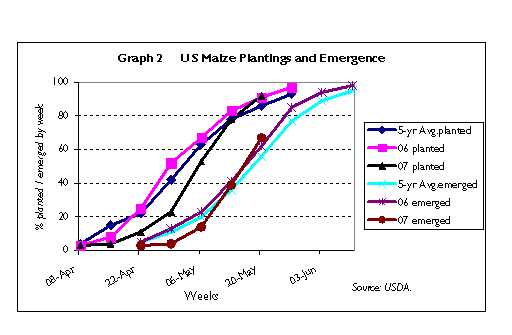 continued
Crop emergence was initially running behind the five-year average but is now ahead. In the first USDA crop condition report for maize, 78% of reporters recorded the crop being in good or excellent condition, above both last year’s rating at this time of 66% and a five-year average for late May of 64%. Currently the US maize crop has to be rated as in the kind of condition needed to meet projected use requirements.
Soyabeans are a shorter season crop and hence planted after maize. The earlier concern was that delays in planting maize would result in a switch in area to soyabeans, to avoid the yield penalty that results from late planting of maize. Farmers had indicated in the USDA’s March prospective planting survey their intention to reduce soyabean area by 11%. In view of the abundant US and global supplies anything that might have limited the anticipated cut in output was not viewed as favourable.
As of May 20 59% of soyabeans had been planted compared with 52% last year and a five- year average of 48%. The crop was reported to be 21% emerged compared with 16% last year and an 18% five-year average. The USDA’s first crop condition report is not made until May 27, but it is evident that the soyabean crop is also off to a good start.
Market Prospects - Although the USDA forecast a 10Mt or 20% recovery in US wheat output next season, which forms a substantial part of the 23Mt projected recovery in global output, this may not have a very negative impact on prices. In the first place global ending stocks are projected to decline by 28Mt and thus an equivalent increase in output is needed if supplies are to match last year’s supply level and meet continuing global needs.
Further, while the feeding of wheat to livestock in the US is usually quite limited, typically about 5Mt compared to 150Mt for maize, if wheat is competitively priced it is likely to be used more liberally. About 13Mt of wheat were fed in 1991 when maize supplies were relatively tight and prices high. Wheat feeding tends to occur in the third calendar quarter, after the wheat harvest and before the maize harvest. Any threat to US maize production, or evidence that US wheat will not find ready overseas markets, will likely result in price relationships that will encourage feeding of US wheat reducing reliance on export markets.
The maize market this year is very different to any that has been seen in recent years. With a very large planted area and a crop appearing to be in very good condition, a record harvest is all but guaranteed. In any year but this, the resulting prospect for supply surplus to needs would result in a very adverse price outlook. Although prices have been, and are likely to continue to be, very volatile, they are more than 50% above year ago levels.
With abundant supplies of soyabeans, both in the US and globally, a weaker market might be anticipated. Over the winter months frequent reference was made of the need for soyabean prices to follow those of maize so farmers would plant a balance of these two crops. Now, however, very strong soya and other vegetable oil markets, and indirectly the energy market and the promise of increased biodiesel production, are currently supporting soyabean prices.
David Walker 001 780 434 7615
top of page